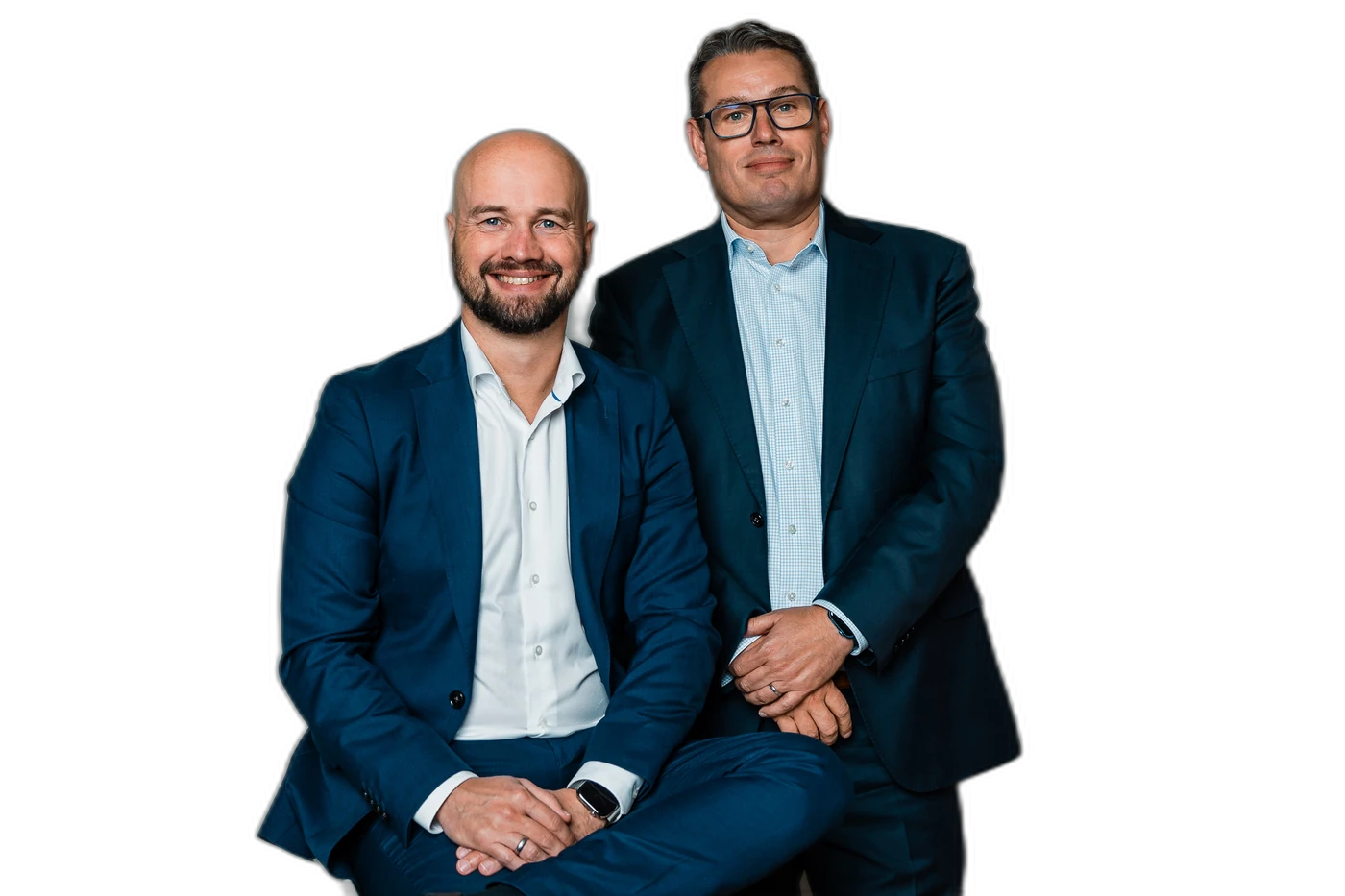
Quilyx is a Dutch IT consultancy, based in Utrecht, The Netherlands. Two founders with over fifty years combined experience in enterprise and government delivery, from KLM and Heineken to Dutch national and municipal government.
Our claim is narrow and testable: we build systems that take over the support tasks, so senior people spend their hours deciding instead of processing.
It shows up in the delivery too: the senior lead owns the plan, the risk and the calls, while the systems do the reading, sorting and surfacing that used to fill those hours. Augmentation, not automation.
AI does not replace programme judgment, it enhances it.
Sovereignty by design: our AI runs on our own hardware in the Netherlands, with local model inference. No foreign cloud or external AI service plays any part in that. Sensitive client and supplier data is never fed to an external AI service. Only our own AI handles it. GDPR and the EU AI Act are design inputs from the start.
The proof
Five systems, each at its own stage
What runs the firm
Quilance
In production · internal use
Our placement-automation engine. It reads inbound assignment streams, splits and triages them, extracts each structured request, and matches it against registered freelance professionals.
01Intake. Assignment streams arrive from marketplaces, sourcing desks and mail.
02Filter. The inbound stream narrows: multi-role requests become single requests.
03Triage. Fit or no fit, fast, with reasons attached.
04Extract. Rate, location, deadline, skills: structured fields instead of prose.
05Match. Ranked against the registered professionals.
06Place. A human decides. The system prepared.
·Freelyx. Registered professionals flow in through our placement portal.
Runs on our own hardwareLocal model inferenceNever fed to external AI
Before its own launch it surfaced our first major result-shaped assignment. Its public face is Freelyx, our placement portal.
QuiDAS
Working engine
A discovery engine that maps where demand surfaces: the procurement portals, dynamic purchasing systems and supplier desks behind which public and private buyers publish their needs.
QuiDAS finds the portals, removes the duplicates and aggregators, and turns the landscape into a worklist.
1,502raw references processed
~190distinct systems still to register
106already connected
13live systems with no portal at all
As of July 2026 · dots illustrative, counts real
A working engine in daily internal use.
Freelyx
Live
Our freelancer placement portal: the public, logged-in face of the Quilance engine. Registered professionals sign in to read the assignments Quilance has surfaced, split and structured.
The portal never holds the link between an account and a person. That link stays on our own hardware, so a portal breach cannot hand anyone a list of names.
01Quilance seals an anonymised assignment export on our own hardware.
02The portal receives it. Two-factor authentication can be switched on for every account.
03A signed-in professional reads the assignment. Nothing is readable without signing in.
No path back. The portal cannot reach our systems, so a portal breach stays a portal breach.
Signing up is free and open through a short form, and a person reviews every application before portal access. Assignments never appear on a public page. Reading them requires signing in.
What we are building next
Prototype
QEPMS
Prototype · synthetic data
A portfolio-intelligence layer for enterprise change. It reads the sources a portfolio already has, normalises them into one model that does not care which delivery method produced them, and emits a single overview with citable board packs, a map of what it does and does not cover, and flags where the sources contradict each other.
Portfolio reporting fails on the feeding, not the reporting. So this one reads the artefacts people already produce instead of asking them to maintain another tracker.
Portfolio202520262027TODAY
Smart Meter RolloutPRINCE2
Grid Balancing PlatformSAFe
Harrowgate Claims System RenewalPRINCE2
Payments ModernisationScrum
Customer Data PlatformNONE
Programme · Harrowgate Claims System Renewal
Claims Core ReplacementPRINCE2
Data MigrationPRINCE2
Channel IntegrationScrum
Legacy DecommissioningLEAN
Project · Data Migration
Source InventoryWP01
Mapping and RulesWP02
Trial MigrationsWP03
Cutover RehearsalWP04
Work package · Trial Migrations
Extract batch 3DONE
Reconciliation reportDONE
Defect triageACTIVE
Sign-off packQUEUED
Prototype board · synthetic data · drawn from the working demo
The core is built and tested, entirely on synthetic portfolio data. A demo is available, running on our own local hardware.
I.R.E.N.E.
Early version running
I Remember Everything, No Exceptions
A digital mirror of a physical brain. What the head files away in long-term memory, the mirror keeps top of mind: current, sourced and one question away, without the head having to carry it. Its design follows how a brain divides work: every compartment has its own store and its own agent, one orchestrator holds them together, and as it grows each compartment gains subagents under its own orchestrator, with one above them all.
The payoff is headroom. A head that does not have to keep everything top of mind is free for the work that needs it whole, for example for running programmes. That is what AI-augmented programme delivery means here.
01Capture. Raw thought in, verbatim, never tidied on the way.
02Facts. Verified, with a source and a date attached.
03Projects. Everything in flight, each carrying one next step.
04Decisions. What was chosen, and what it superseded.
05Commitments. Dated, and either met or still open.
06Shielded. Closed by design. What is in there is not shown here, or anywhere.
Provenance on every factEvidence thresholdContradiction flags
A first version already runs inside the firm every day, on hosted models. The version that runs on our own hardware is being built now.
The approach
How we run AI
Humans decide, systems prepare
Every output lands in a human workflow. Nothing auto-commits, nothing auto-sends.
Sovereignty by design
The AI runs on our own hardware in the Netherlands. European data law is a design input, not an afterthought.
Build small, run real
A system earns a bigger job by doing a small one in daily operation first.
This site works the same way: static files, no trackers, no third-party requests, built by AI agents and reviewed by the people below. The colophon has the receipts.
The founders
Who is behind it
Jeffry Turfboer
Founder · Channel 01
Engineer turned programme leader.More than twenty-five years of enterprise IT delivery.Claude Certified Architect (2026).Builds the systems on this page.
Bjorn van Rosengarten
Founder · Channel 02
Public-sector executive and programme leader.Former CTO at the City of Rotterdam.Led the Dutch municipalities’ information-security service (IBD).Runs the government practice.
Utrecht · NLTwo foundersQuilyx B.V.
Member of NVIDIA InceptionRegistered Partner in the Claude Partner Network (CPN)
Program memberships, not endorsements. The NVIDIA Inception badge is shown under the program’s member guidelines.
In person
NVIDIA GTC Berlin
20-22 October 2026. We will be there, with our working systems running live. If we met at GTC, this page is the follow-up we promised.
Contact
Talk to us
One address, no forms, no funnels. It reaches the founders directly.